Friday, July 4, 2014

Political unrest poses dire risk to country's economy

Bangladesh faces serious economic consequences from ongoing political unrest, writes Asif Reza Akash, 22, a Correspondent from Dhaka in Bangladesh, who says strikes are taking a toll in rising prices and lost income.

Bangladesh has passed its tenth national parliamentary election under an amended constitution. The previous opposition and major political party BNP and its alliance boycotted the election and put the country under continuous strikes from the early part of October 2013. The economy suffered from this political turmoil, without any doubt. Bangladesh was stagnant for two or three months and surely lagged behind countries such as India, Vietnam, China, and Myanmar in terms of trade, commerce and export.

Garments and textiles, Bangladesh’s biggest sector, has virtually been ruled out of competition as a global exporter country for those turbulent months. Food security has been threatened. Production and investment is clearly facing a downward move. The flow of remittance has declined and watchdog organizations like the World Bank and IMF have expressed their deep concern. In the fiscal year 2013-14, the GDP was anticipated to grow 7.2 per cent, but current World Bank estimates are just 5.7 per cent. Individual-level investment has reportedly been reduced by one to two per cent. Manpower export has receded, which could have a negative impact on remittance inflow.

The textile sector already suffered an image crisis with the Tazreen fire and the RanaPlaza collapse, but the political unrest has destroyed the resilience of this sector. Many import orders from European delegates have been placed in India, Vietnam and other countries instead of Bangladesh. Coming up in June there will be a review of the garment sector by the European Union and if Bangladesh loses, it will be fatal for the textile sector. Though Bangladesh is second in garments export it can lose its position at any time if further actions are not taken. Bangladesh’s Garment Manufacturers and Exporters Association (BGMEA) president claimed that the sector incurred a loss of over Tk. 2,000 crore in the street violence of October and November, while orders worth $2.40 million were cancelled from December 1 to 9.

The banking sector is at a halt now. Newspaper reports show that 28,000 crore taka is deposited idle in bank vaults. Loan supplies, repayment, and banking services have been facing a standstill. Even the world recession of 2008 didn’t affect the banking industry as much as the on-going political unrest did. China’s industry offered to invest ten billion USD in Bangladesh, but later postponed on the grounds of political instability. An important Memorandum of Understanding (MoE) was about to be signed between the UAE and Bangladesh on November 03 but was postponed later for the same reason (Dr. Mijanur Rahman Shelly, 03/12/2013, Bonik Barta).

The worldwide inflationary trend showcases a downfall recently as international food prices have fallen, but here in Bangladesh food prices have increased because of the nationwide blockade. Food carriers have been attacked in many places, which reduces the supply of food in urban areas. As a result prices go up. The transportation charge has increased at least threefold as driving during the strikes involves a high level of risk. In many parts of the country, especially north Bengal, farmers became unable to transport foods and grains to the cities and were deprived of their rightful price. This is how political unrest is forcing city dwellers to buy food at a higher price and keeping the farmers from realizing proper income.The transportation business has suffered greatly. Almost every day, there have been attacks and torchings of cars and buses. From highway to streets there was and still is a continuous tension. A report in BSS (Bangladesh Songbad Songstha) states that “unruly protesters damaged over 350 motor vehicles and torched 325 others at different places of the country during the period from November 25 to December 11”. The same report says “310 violent and sabotage attacks were posed on railway coaches causing a loss of Tk. 10 crore during the period from October 10 to December 9, 2013”.

It is imperative to mention here that, although Bangladesh is advancing and the per capita GDP has risen, a great number of people still live hand to mouth. The rickshaw pullers, CNG drivers, hawkers and many classes of people depend on a meagre daily income. The continuous strike and nationwide blockade has forced them into deprivation. According to Atiqul Islam, President of BGMEA, about five million people working in the RMG sector suffer a loss of Tk. 250 crore on each day of the blockade.

The economy has faced a disaster in this turmoil. Though academically politics and economics are different majors, we must see them as an intertwining subject. The economy cannot go a single step further without proper politics. We cannot afford an economic setback at this juncture, as Bangladesh wants to be a middle income country within the least possible time. The sooner the politicians admit this fact the better it is for the country’s people. 
This article was published in a youth blog under commonwealth on Feb 12, 2014

Link: Click Here

New Power Plant Threatens Agriculture and Food Security in Bangladesh

The government of Bangladesh is advancing plans to install a coal-based thermal power plant in the area of Rampal in the Bagerhaat district. This project is only 10 kilometers away from the Sundarbans, an environmentally critical area, and threatens its very existence.
The Rampal power plant will have hazardous impacts on agriculture and food security, diversity of plants and wildlife, fisheries, the life of local inhabitants, and the area’s topography. The power plant will generate 1,320 megawatts of electricity and will occupy 1,834 acres of land, which is mostly agricultural and shrimp aquaculture ponds.
The distance of the plant from the Sundarbans cannot be considered safe. Its impact on agriculture and food security is so fatal that we cannot sustain and support the project. Unfortunately, the government is going ahead by ignoring public protest.
Though an Environmental Impact Assessment (EIA) report was published in January 2013, its methodology, findings, and recommendations have been highly criticized and even revoked by many specialists because of its deficiencies in estimations and disclosures of truth, as well as for its ambiguity.
The EIA report by the Center for Environment and Geographic Information Services took an area of 10 kilometer radius from the stack location of the proposed plant and showed 75.4 percent (26,344 hectares) is Net Cultivable Area (NCA) in their study scope of 34,955 hectares. It suggests that only 706 hectares of NCA will be compromised by the project site, but it actually has a lethal and circular impact on agriculture.
Once the plant is in operation, it needs huge amounts of coal supplies and the materials used in it will emit hazardous chemicals such as sulfur, carbon dioxide, cadmium, radium, arsenic, lead, mercury and nickel. Reportedly, 220 tons of different toxic gases will be discharged daily from the plant unless they are treated appropriately before emission.
These gases will be spread out by wind and affect the people, trees, soil and livestock. The soil texture (sand, silt and clay) will be damaged by the discharged toxic chemicals, and it will extensively decrease land fertility and production over time.
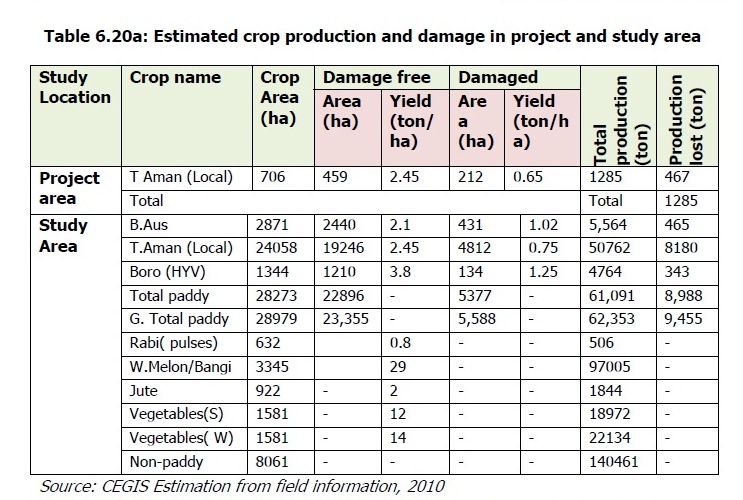
Interestingly, within 743 hectares of land of the proposed plant, 706 hectares (95 percent) is agricultural land. The EIA report says that 459 of the 706 hectares is a damage-free area, and the lost production is only 467 tons of crops, but that is simply an underestimation of the consequences.
The EIA report also shows annual production loss of paddy is about 9,455 metric tons (project area 467 tons and study area 8,988 tons).
The air, odor and sound pollution will affect local inhabitants and cattle so badly that it will be hardly possible for people to live and cultivate outside of the study area. The study area now produces 62,353 metric tons of rice and 140,461 metric tons of other crops annually.
The EIA report also estimates that the livestock and poultry population per household in the study area comprises three cattle, two buffaloes, four goats, one sheep, five ducks and six chickens.
The power plant will reduce the livestock grazing area, and the wastes from coal such as fly ashes and bottom ashes will contaminate air and water. This will make the livestock vulnerable to diseases and will affect the income level of households and farms simultaneously.
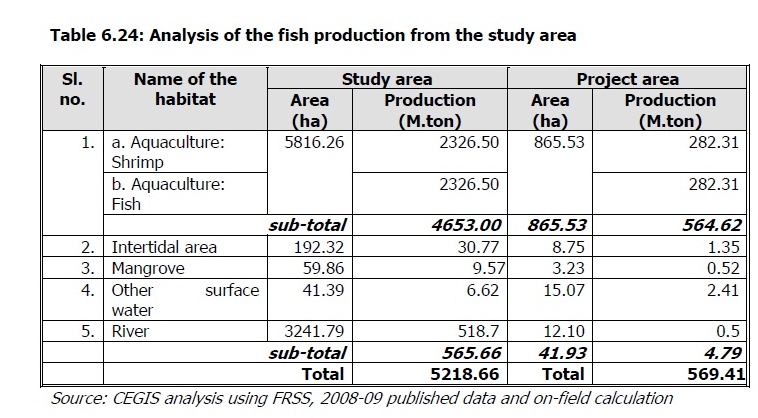
The most deadly impact will be on fisheries. The fishery resources of the project area are enriched with around 120 aquatic fauna, including hilsha, taposhi, bhetki, parsheand, rita, faisha and tulardandi, to name a few from the long list.
The Passur River is a source of larvae for the shrimp and the confluence of rivers provide some unique places for the propagation of fish.
The aquatic species are already facing extinction due to a number of different factors, such as the hindrance of fish migratory routes, changes to the geomorphological processes of  rivers, rapid siltation of  fish habitats, squeezing of spawning and feeding grounds, and the expansion of culture fisheries.
If the coal power plant is installed, it will accelerate the extinction process of the fisheries. The plant will require 9,150 cubic meters of water per hour from the Passur River for its operation. The discharged water will be toxic and have a destructive effect on the fisheries.
The oil and chemical wastes from coal-carrying vessels will contaminate the water. The Passur River will be the first victim of the power plant, followed by the Passur-Chunkuri confluence, Maidara, and Tidal Khal.
Mangrove-supported habitat will also suffer, and shrimp farms and homestead fish ponds will be no exception.
Whatever report the government published to get the environmental clearance is totally a whitewash. The benefits of this project can never outweigh the consequences.
This initiative must be stopped at any cost. This project will not only hamper Bangladesh in food and agriculture, but also make it vulnerable to natural disasters and calamities that we can barely imagine.
This article was published in 'Food Safety News' magazine from Seattle, USA on Oct 22, 2013
Link: Click Here

RMG sector: Getting paid as you perform

The ready-made garment (RMG) sector that began its journey in the 1980s has emerged the biggest part of our manufacturing industry. Now, it employs more than 4.5 million workers, mainly women from low income families. But the main problem that still remains unresolved to a large extent is the wage structure for workers, who are mainly labourers doing blue-collar jobs. We experienced unrest, vandalism and strike in this sector over the workers' minimum wage demand. But is the minimum wage the best solution? If we visit economic theories, we see a rational individual acts in the best interest of his or her own. Adam Smith chose to call it 'self-love'. This passion of a man drives him to gather wealth for ensuring a comfortable today and a better future. The owners of the garments factories and the workers are no exception. However, the self-interest is not a bad thing until it affects others' legitimate rights. So an owner's inclination for making more profit by reducing the expenses is as simple as it is. On the contrary, the workers want better wages to meet their basic needs. Hence, to solve the conflict of interest and the wage problem, we need to address the problem from both the owners' and workers' perspectives.

What if we introduce performance-based pay or any profit-sharing plan? Economist Martin L. Weitzman, a professor of Harvard Kennedy School, came up with a beautiful but simple equation: Y=MX+C, where Y denotes the total earnings of a worker, M is the reward rate, X is the variable and C is the fixed wage. In our country, C is high, though many people may disagree, and there is no reward for performance. That means the MX is missing. Our goal is to ensure betterment of the workers by not harming the owners' interest either. So, we can reduce C and introduce some variables and rates, based on which the workers will be paid for their performance. The benefits for workers should have its lower and upper limits. A standard could be set in this connection based on agreements between workers and owners. This has various advantages. Once the standard is set, the workers will be more motivated to put up the best performance and this will lead to a higher earning (Y) than before (when C was higher and fixed). Weitzman did research on fixed versus profit sharing wages and their effect on unemployment. He has argued that when firms offer profit sharing wages, that means employees receive higher wages when a company is doing well, firms have the lower rates of unemployment and do better during any recession. If the economy experiences any downturn, the owners have nothing to be worried about, because if firms earn no profit, then they do not need to pay on performance, since the source of MX is the profit but the owners must continue to pay the fixed wages which is not difficult now, because C is now lower. If C is a big figure, a slowdown of an economy can destroy the firms, leading to higher unemployment and unstableness in a country. That's how MX could work as a shock absorbent factor for the firms.

It is easy to understand that if MX is higher, then Y will be higher as well. So the workers will be satisfied and they will cooperate with the owners. Unrest, vandalism and strike will never be there. This will result in a stable industry. Nevertheless, accounting experts see something different in Weitzman's theory and call the above logics legitimate but a layman's notion. They argue that a higher MX will reduce the monitoring costs. When C is higher and fixed, the workers tend to shirk. So, firms need supervisers, foremen, surveillance and other similar things, but performance-related pay (PRP) can reduce this cost and improve the workers' efficiency. Economists view it from a wider perspective. They believe if the money is in the pockets of owners, who are already well off, they will spend it for luxury. They will travel overseas, buy apartments, ornaments, latest techno devices and thus money will be drained out to foreign countries. But more money in the workers' hands will have a more positive impact on the economy. They will meet their basic needs by this money. They will buy food stuffs, clothes and many other things. So, the demand for those products will be higher and it will help enhance their production and supply resulting in a higher purchasing power of the lower class people. This will also help create more jobs and have a positive impact on gross domestic product (GDP).

Now the question is: Can Bangladesh can apply this theory at this juncture? The answer is 'yes but gradually'. The trouble with its implementation is we have a large workforce. But workers are often disorganised and unskilled. So, owners and investors will not be willing to accept Weitzman's theory right now. But the government should persuade the investors to set up factories by providing lucrative tax benefits. The profit sharing with employees is regulated by the government under the Companies Profit Act, 1968 (amended in 1989). The existing act is fine but the government can impose such profit sharing plans on big firms through gazette notification time to time on the basis of mutual agreements. To do this, owners must shun the hardcore capitalistic mindset and the government should shun the extreme fondness for the wealthy owners and, most importantly, they should overcome the narrow partisan interest for the sake of building a better society.

This article was published in The Financial Express, May 29, 2014
Link: Click Here